
Cross-Channel Pet Travel for Second-Home Owners & Frequent Commuters: The Complete UK–France Le Shuttle Mobility Guide
For thousands of British and international families, life is split gracefully across the English Channel. A primary residence in Kensington, Surrey, or the rolling hills of the Cotswolds balances seamlessly with a stone farmhouse in the Dordogne, a vineyard bastide in Provence, a seaside retreat in Normandy, or a winter chalet in the French Alps. Yet, beneath the idyllic rhythm of dual-residency living lies a recurring, high-stakes operational hurdle: transporting the family dog or cat back and forth without administrative burnout, animal exhaustion, or regulatory quarantine traps.
Since Brexit fundamentally altered the European pet travel landscape, cross-border animal movement is no longer a passive administrative afterthought. Frequent commuters quickly discover that traditional travel modes fail them. Commercial airlines legally prohibit pets from flying in the passenger cabin into United Kingdom airports under Department for Environment, Food & Rural Affairs (DEFRA) biosecurity rules. Cross-channel passenger ferries often require animals to remain locked alone in cold vehicle decks or noisy public kennels for hours. Meanwhile, commercial multi-drop pet courier vans operate on erratic commercial timetables, co-mingling dozens of unfamiliar animals in stacked wire cages.
For second-home owners who travel three, four, or six times a year, the only sustainable, dignified solution is dedicated private road transit via Eurotunnel Le Shuttle. Traveling door-to-door in an executive estate vehicle with personal belongings, seasonal wardrobes, sporting gear, and companion animals seated peacefully alongside their owners transforms a stressful biosecurity gauntlet into an unhurried extension of the holiday itself.
This comprehensive guide details the logistics, legal frameworks, veterinary shortcuts, and vehicle ergonomics required for seamless, stress-free cross-Channel commuting with your pets.
The Dual-Residency Reality: Why Frequent Channel Commuters Face a Unique Hurdle
Relocating across borders once in a lifetime is an intensive logistical project; commuting across borders multiple times every year is an ongoing lifestyle discipline. Pet owners who split their calendar between Great Britain and mainland Europe quickly realize that single-use relocation advice does not apply to their situation.
Frequent cross-Channel commuters encounter four distinct friction points:
- The Paperwork Fatigue Cycle: Obtaining a single-use Animal Health Certificate (AHC) from a UK veterinary practice before every single departure from Britain costs £150 to £250 per trip, rapidly accumulating into thousands of pounds annually in duplicative paperwork fees.
- Voluminous Seasonal Cargo: Commuting between two fully furnished homes involves transporting extensive luggage: winter ski equipment, golf clubs, cases of regional French wine, work equipment, and oversized orthopedic dog beds. Standard taxis and public transit cannot accommodate this combination.
- Animal Behavioral Continuity: Moving a dog or cat between territories several times a year requires consistent environmental cues. Subjecting an animal to noisy ferry engine vibrations or the solitary confinement of an aircraft cargo hold repeatedly induces chronic anticipatory travel anxiety.
- Punctuality & Schedule Flexibility: Second-home owners cannot afford rigid courier pickup windows that stretch across three-day delivery estimates. Departures must align precisely with work obligations, school breaks, and personal itineraries.
Understanding these pain points is the first step toward building an effortless, repeatable travel routine between your UK and European residences.
The Post-Brexit Paperwork Landscape: AHC vs. The EU Pet Passport
The single greatest source of confusion—and unnecessary expense—for second-home owners is navigating post-Brexit pet documentation. Following the UK’s transition to “Part 2 third country” status under the EU Pet Travel Scheme, old blue British-issued EU Pet Passports were permanently invalidated for entry into the European Union.
However, how you manage your documents depends heavily on whether your pet qualifies for a genuine European Union Pet Passport.
Animal Health Certificate (AHC)
Standard post-Brexit document issued by UK Official Veterinarians (OVs).
- Valid for: Entry into the EU within 10 days of issue; onward EU travel for 4 months; re-entry to the UK within 4 months.
- Single-Use Limitation: Once you re-enter the UK, the AHC expires permanently for future outbound travel.
- Typical Cost: £150 to £250+ per certificate from UK vets.
- Best for: Occasional holidaymakers or one-off movers.
EU Pet Passport (The Frequent Flyer Solution)
Multi-use lifetime document issued by a registered veterinary surgeon in an EU member state.
- Valid for: Unlimited travel between the EU and UK for the lifetime of the animal (provided the rabies booster remains continuous).
- Repeat-Use Advantage: Zero paperwork fees per trip. Eliminates the need for pre-travel AHC vet appointments in the UK.
- Prerequisite: Must be issued in France, Spain, Ireland, or another EU state based on physical examination and rabies vaccination within the EU.
- Best for: Second-home owners and frequent cross-Channel travelers.
The EU Pet Passport Strategy for Dual-Residents
If you own property in France or spend several months a year in mainland Europe, securing an authentic EU Pet Passport is the single most cost-effective decision you can make.
Under EU Regulation 576/2013, an authorized veterinarian in France (or any EU member state) can issue an EU Pet Passport for your animal. To maintain legal validity:
- The animal must already possess an ISO 11784/11785 compliant microchip.
- The rabies vaccination recorded in the passport must be administered or revaccinated by a licensed EU veterinary surgeon.
- UK veterinarians are legally prohibited from stamping or updating rabies booster entries in an EU passport. Therefore, your pet’s ongoing rabies boosters must be administered while you are in France or Europe before the previous booster expires.
By maintaining a French or EU Pet Passport, you can cross the Channel back and forth indefinitely without ever paying for an Animal Health Certificate again. For full regulatory context, consult our exhaustive breakdown on UK to EU pet travel rules.
Why Traditional Cross-Channel Transport Fails Second-Home Pet Parents
When planning a seasonal move between London and a European residence, homeowners evaluate four traditional transportation modes before turning to dedicated road transport:
A. Commercial Airline Travel: The Manifest Freight Impasse
The most common misconception among transatlantic and European expats is assuming they can book an in-cabin pet flight directly into the UK. DEFRA biosecurity statutes mandate that no commercial airline may fly companion animals into any British commercial airport in the passenger cabin. Every animal landing at London Heathrow, Gatwick, or Manchester must fly manifested in the unpressurized aircraft cargo hold.
For a family traveling multiple times a year, putting a beloved pet into airline cargo is unviable. Beyond the extreme expense—routinely exceeding £2,000 to £4,000 per leg according to IATA Live Animals Regulations (LAR) freight schedules—the process involves mandatory 4 to 8-hour processing queues at the Heathrow Animal Reception Centre (HARC), thermal fluctuations, and severe psychological distress.
B. Cross-Channel Ferries: The Noise and Isolation Risk
While select ferry operators offer pet-friendly cabins on longer routes (such as Portsmouth to St Malo or Caen), spaces are limited and booked months in advance. On high-frequency Dover–Calais ferry crossings, pet parents are legally prohibited from remaining on vehicle decks during the voyage. Dogs and cats must either stay alone inside your vehicle or be placed in communal metal kennels near vehicle engine rumbles and car alarms. For sensitive animals, 90 minutes of solitary sea turbulence and mechanical clatter creates deep-seated travel trauma.
C. Commercial Multi-Drop Courier Vans: The “Parcel Treatment”
General pet courier companies bundle 10 to 18 animals from different owners into a single high-roof van, crisscrossing the continent on multi-day delivery routes. Animals are confined to stacked wire crates, surrounded by barking, unfamiliar animals, and subjected to unpredictable feeding and walking schedules. For high-net-worth second-home owners seeking bespoke care, trusting an anxious pet to an unmonitored commercial freight network is simply not an option.
D. Solo Driving Exhaustion: The Fatigue Barrier
Driving oneself between the UK and southwestern France or the Mediterranean coast involves 12 to 16 hours behind the wheel across French toll motorways (autoroutes), managing international border controls, navigation, and fuel stops alone. When managing an anxious animal and heavy personal luggage simultaneously, driver fatigue becomes a serious road safety concern.
The Eurotunnel Le Shuttle Experience: The Gold Standard for Pet Comfort
The 35-minute railway journey beneath the English Channel via Eurotunnel Le Shuttle (operating between Folkestone, Kent and Coquelles/Calais, France) is universally recognized by veterinary behaviorists as the safest, least stressful crossing method for domestic animals.
Why Eurotunnel Le Shuttle is Unmatched for Pets
- Complete Presence: You remain seated beside your pet inside your private vehicle cabin throughout the journey.
- Rapid Crossing Time: Just 35 minutes platform-to-platform (underwater transit).
- Zero Altitude Shifts: No barometric ear pressure, zero cargo turbulence, and zero sea sickness.
- Dedicated Pet Lounge: Specialized DEFRA Pet Reception facilities at Calais and Folkestone.
- Multi-Zone Climate: Smooth electric rail propulsion with continuous vehicle air-conditioning cooling.
The Calais Pet Reception Workflow: How It Works
When returning to Great Britain from your European second home, your vehicle must clear the Eurotunnel Pet Reception Centre in Calais prior to boarding the train. Here is the operational sequence:
- Pre-Check Arrival: You arrive at the dedicated Pet Reception building at the Calais terminal at least 60 to 90 minutes prior to your scheduled shuttle departure.
- Microchip Verification: An official Eurotunnel check-in agent presents a handheld universal microchip scanner through the vehicle window or inside the reception pavilion. You scan your pet’s microchip yourself, verifying that the 15-digit number matches your paperwork precisely.
- Veterinary Documentation Check: The agent examines the original EU Pet Passport or UK Animal Health Certificate, verifying the rabies immunization dates and the mandatory tapeworm treatment.
- Fast-Track Boarding Pass Issued: Once approved, your pet receives an official Eurotunnel travel badge and boarding hanger, allowing your vehicle to proceed directly through French and UK Border Force passport lanes onto the train carriages.
For an extensive analysis of why this crossing outperforms maritime alternatives, read our detailed guide on Eurotunnel pet transport vs ferries.
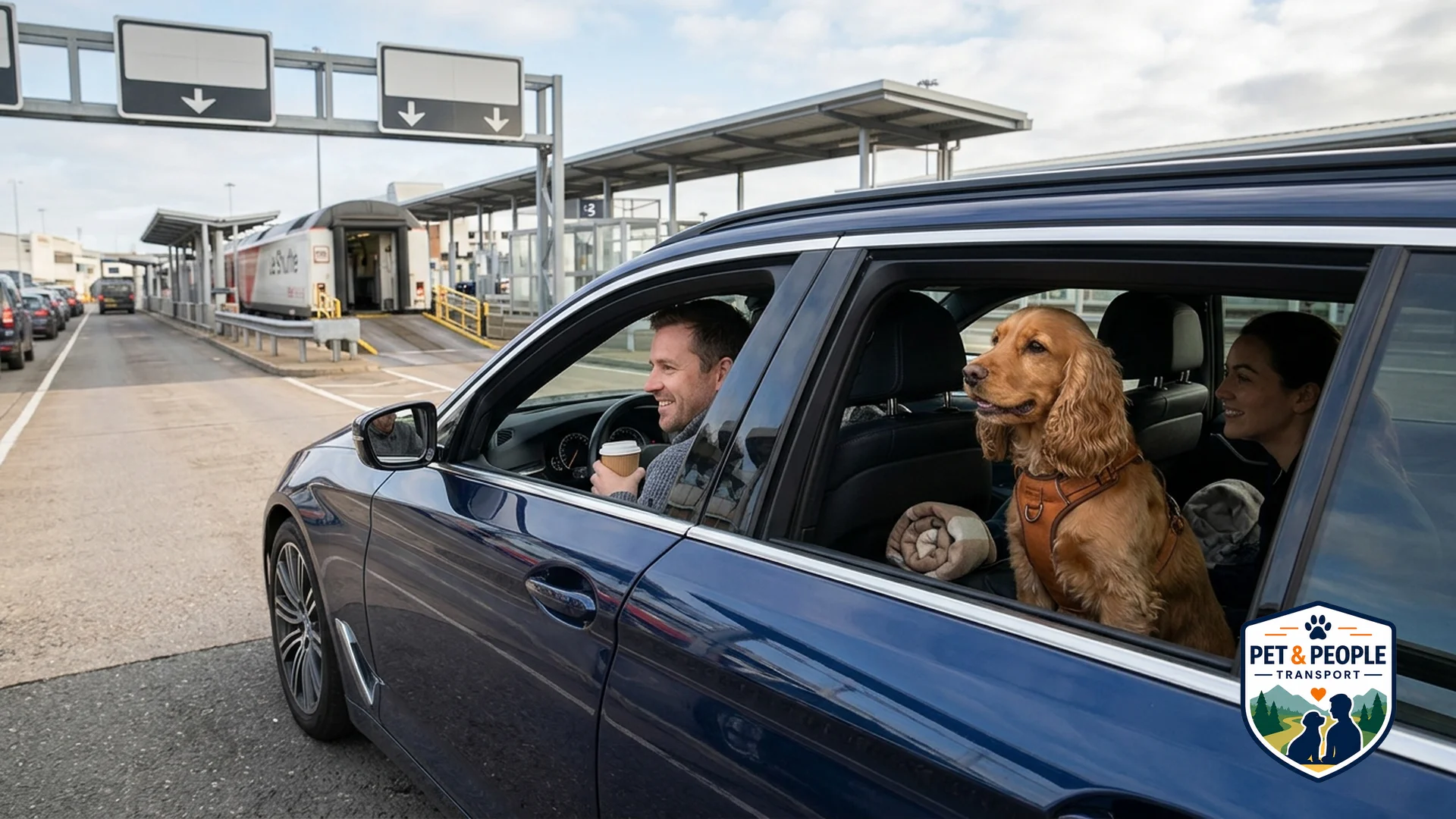
Eurotunnel Le Shuttle boarding lane for frequent pet commuters in an executive BMW 5 Series Touring estate
The Critical Veterinary Synchronization: Tapeworm Rules & Border Clearance
When traveling outbound from the UK to France, the legal requirements are straightforward: an ISO microchip, an up-to-date rabies vaccine (administered at least 21 days prior to initial border crossing), and an AHC or EU Pet Passport.
However, the return leg entering Great Britain is where 90% of border rejections occur. The UK government enforces an uncompromising statutory rule regarding canine tapeworm treatment (*Echinococcus multilocularis*).
The 24-Hour to 120-Hour Tapeworm Protocol (Dogs Only)
Under DEFRA rules, every dog entering the United Kingdom must be treated for tapeworm by a licensed veterinarian in mainland Europe. The treatment must satisfy strict criteria:
- Approved Active Substance: The medication must contain Praziquantel (or an equivalent officially licensed substance effective against *Echinococcus multilocularis*).
- The Precise Time Window: The treatment must be administered no less than 24 hours and no more than 120 hours (5 days) before the exact scheduled time of vehicle check-in at Eurotunnel Calais.
- Veterinary Passport Endorsement: The European vet must personally record the product trade name, manufacturer, exact date, and precise minute of administration into Section VII of your EU Pet Passport (or the relevant page of your AHC), authenticated with their signature and official clinical practice stamp.
> [!WARNING] > The 23-Hour and 59-Minute Trap: Eurotunnel check-in systems calculate compliance strictly by the minute. If your vet administered the tapeworm tablet at 10:00 AM on Friday, and you arrive at the Calais check-in desk at 09:50 AM on Saturday, your dog is at 23 hours and 50 minutes. You will be legally barred from boarding until the full 24-hour mark has passed. Conversely, arriving at 120 hours and 5 minutes results in absolute rejection, requiring a complete re-treatment and another 24-hour waiting delay in France.
When traveling with Pet & People Transport UK, our dispatch team conducts a complimentary pre-travel document audit 48 hours prior to departure, cross-checking the exact timestamp against our scheduled Calais crossing to ensure instant, zero-delay clearance.
Executive Estate Mobility: The Luxury of Space, Silence, and Luggage
The physical vehicle you travel in defines the entire character of your cross-Channel journey. Commercial courier vans utilize stiff commercial chassis, bare cargo walls, and loud diesel drivetrains that amplify road vibration.
Pet & People Transport UK operates exclusively with executive estate models: the Mercedes-Benz E-Class Estate, the BMW 5 Series Touring, and the Volkswagen Passat Estate.
Cavernous Boot Capacity (640L – 1,800L)
Second-home living requires substantial gear. Our long-wheelbase estate cars swallow 4 large hard-shell suitcases, multiple weekend duffels, sports apparel, regional wine crates, and work technology—all securely partitioned away from the passenger cabin.
Multi-Zone Acoustic Insulation
Double-glazed acoustic glass and adaptive air suspension cushion road joints and cobblestones. Dogs sensitive to road hum rest in deep slumber, undisturbed by exterior highway turbulence.
Cage-Free Ergonomic Seating
Zero metal wire cages. Canine passengers relax on orthopedic memory foam travel mats secured by crash-tested, padded chest harnesses. Feline travelers enjoy pheromone-soothed sanctuary carriers placed securely right beside their owners.
Strategic Commuter Corridors: Popular UK to European Routes
Our private pet chauffeur service regularly operates seamless door-to-door transit along key dual-residency corridors connecting Great Britain and mainland Europe:
Route 1: London & Kent to Normandy & Brittany (The Coastal Corridor)
- Typical Journey Time: 4 to 6 hours from Folkestone.
- Key Route: Folkestone to Calais via Eurotunnel → A16 south past Boulogne-sur-Mer and Abbeville → A28 towards Rouen, Caen, and Deauville.
- Commuter Appeal: Highly accessible for long weekends and seasonal escapes. Our chauffeurs coordinate morning pickups in central London, clearing the Channel before midday and arriving at your Normandy manor in time for afternoon tea.
Route 2: The Cotswolds / London to Dordogne & Bordeaux (The Southwest Gateway)
- Typical Journey Time: 9 to 12 hours (optional luxury pet-friendly overnight stop or continuous dual-driver transit).
- Key Route: Calais → A26 past Arras and Reims → A10/A20 corridor south past Orléans, Limoges, and Périgueux.
- Commuter Appeal: The quintessential British expat second-home corridor. Bi-hourly comfort stops at serene, green French roadside aires allow dogs to stretch and hydrate, avoiding the stress of long highway slogs.
Route 3: London to the French Alps & Geneva Basin (The Alpine Commute)
- Typical Journey Time: 8 to 10 hours from Calais.
- Key Route: Calais → A26 towards Dijon → A39 / A40 (Autoroute des Blanche) heading towards Chamonix, Annecy, or the Swiss border.
- Commuter Appeal: Popular for winter ski seasons and summer hiking retreats. Our vehicles handle Alpine winter ascents with snow-rated safety equipment and heated rear seating to keep recovering athletic dogs thoroughly warm.
For those considering long-distance road trips further south, explore our definitive guide on driving a dog from Spain to the UK.
Honest Modality Comparison: Evaluating Your Second-Home Options
Choosing how your family and pets travel between homes requires balancing convenience, animal welfare, predictability, and total expenditure.
| Travel Feature | Airline Manifest Cargo | Commercial Courier Van | Passenger Ferry | Pet & People Private Chauffeur |
|---|---|---|---|---|
| Owner Accompanied | No (Separated in cargo) | No (Van transit only) | Partial (Cabin dependent) | Yes (100% Together) |
| Crossing Method | Air freight to London | Eurotunnel or Ferry | Maritime crossing (1.5h – 6h) | Eurotunnel Le Shuttle (35 min) |
| Luggage & Cargo Capacity | Strict airline limits | Zero personal luggage | Car boot capacity | Up to 640L+ Executive Estate |
| Animal Confinement | Rigid IATA metal/plastic crate | Stacked wire delivery cages | Car deck or ship kennel | Cage-free orthopedic seating |
| Schedule Control | Rigid airline flight times | Multi-day delivery window | Fixed sailing times | 100% Bespoke doorstep timing |
To understand how professional road mobility compares with traditional budget alternatives, review our detailed guide on the true cost of pet transport from Europe to the UK.
Frequently Asked Questions
1. Can I use my old UK-issued EU Pet Passport for frequent trips to France?
No. Following Brexit, all EU Pet Passports issued in the UK (blue passports) became permanently invalid for travel into the European Union. You must either obtain an Animal Health Certificate (AHC) from an authorized UK vet for every outbound journey, or obtain an authentic EU Pet Passport issued by an authorized veterinarian in France or another EU member state.
2. How can a UK second-home owner legally obtain an EU Pet Passport in France?
Under EU Regulation 576/2013, an authorized French veterinarian can issue an EU Pet Passport provided your pet is microchipped and physically present in France. The vet will administer or verify a rabies vaccine and register the animal in the French national database (I-CAD). To keep the passport legally valid indefinitely, all future rabies boosters must be administered by a licensed EU vet, as UK vets cannot legally sign or stamp an EU passport.
3. What happens if my dog’s tapeworm treatment is given 23 hours before Eurotunnel check-in?
DEFRA rules are strictly enforced by the minute at the Calais Pet Reception. If the tapeworm treatment was administered less than 24 hours prior to check-in, Eurotunnel will refuse boarding until the 24-hour mark is reached. You must wait at the terminal until the precise minute of compliance has passed.
4. Can my pet stay with me in the vehicle while crossing Eurotunnel Le Shuttle?
Yes. This is the primary reason second-home owners prefer Eurotunnel over ferries and air travel. Throughout the entire 35-minute underwater crossing, you and your pet remain seated together inside the climate-controlled comfort of our executive estate vehicle. There are no cages, no noisy communal kennels, and zero sea turbulence.
5. How much luggage and personal gear can we bring on a private pet chauffeur trip?
Our executive estate fleet (Mercedes-Benz E-Class Estate, BMW 5 Series Touring, and VW Passat Estate) features cavernous cargo bays offering 640 to 1,800 liters of storage. We can comfortably accommodate 3 to 4 large hard-shell suitcases, multiple carry-ons, sporting equipment (golf clubs, ski bags), cases of wine, and your pet’s bedding without crowding the passenger seating area.
6. How do I book a private chauffeur for my next cross-Channel journey?
Every journey with Pet & People Transport UK is 100% personalized based on your exact doorstep collection address, preferred crossing times, passenger count, and pet requirements. Simply request a bespoke quote via our online booking form at Get a Quote, and our travel coordinators will tailor an executive itinerary for you and your companion.
—Preparing Your Property & Routine for Seamless Seasonal Transitions
Experienced cross-Channel pet owners cultivate an organized seasonal routine that minimizes last-minute panic. Implementing these three foundational practices guarantees smooth transitions:
1. Establish a Primary French Veterinary Partnership
Register your pet with an English-speaking veterinary clinic near your European home (or along your primary route near Calais or Rouen). Schedule your pet’s annual rabies booster and health checks during your time in France. This ensures that your pet’s EU Pet Passport remains fully current under the direct care of an authorized European practitioner.
2. Standardize Your Travel Kit
Keep a duplicate set of essentials at each home: heavy ceramic bowls, winter coats, spare leads, grooming brushes, and bedding. When packing for the journey, you only need to transport daily medication, the original pet passport, and a familiar blanket carrying your home scent to cushion the journey.
3. Rely on Dedicated Doorstep Chauffeurs
Rather than navigating congested terminal traffic, border queues, and unfamiliar highway diversions yourself, working with a professional service like Pet & People Transport UK turns travel day into a peaceful, productive interlude. While your chauffeur handles driving, tolls, Eurotunnel check-in, and DEFRA document verification, you can conduct business calls, relax with a book, or enjoy quality quiet time beside your companion.