
Relocating with Dogs and Cats to the UK: The Multi-Pet Cross-Border Travel & Welfare Guide
Relocating an entire household across European borders is an intricate logistical exercise. When that household includes both canine and feline family members, the complexity multiplies exponentially. Dogs and cats experience environmental transitions through fundamentally divergent physiological and psychological lenses. While a Golden Retriever may greet a road journey with curious tail wags and an eager appetite for scenic rest stops, a British Shorthair or domestic tabby perceives vehicle motion, unfamiliar scents, and acoustic shifts as acute territory disruption.
Navigating post-Brexit UK Animal and Plant Health Agency (APHA) and DEFRA border compliance adds a second layer of strict governance. From asymmetric tapeworm rules to the statutory 5-pet non-commercial ceiling, bringing multiple companion animals into Great Britain requires meticulous veterinary scheduling, route planning, and dedicated vehicle space.
This comprehensive manual provides multi-pet families, international expats, and dual-residency owners with the authoritative blueprint for relocating dogs and cats together into the United Kingdom with zero trauma, zero kennel confinement, and flawless regulatory compliance.
The Multi-Species Relocation Paradox: Canine Psychology vs. Feline Stress
The fundamental flaw in standard commercial pet transport is treating multi-pet households as uniform cargo parcels. In high-density courier vans, dogs and cats are routinely stacked in wire crates within inches of one another. The sensory consequence is severe: relentless canine barking and scent markings trigger acute feline neuroendocrine panic, often inducing stress-induced feline idiopathic cystitis (FIC), severe gastrointestinal stasis, or hyperthermia.
To transport dogs and cats together successfully, their divergent welfare requirements must be reconciled through spatial isolation, tailored micro-climates, and dedicated journey pacing.
Understanding the Divergence
Canine Travel Welfare Profile
- Primary need: Regular kinetic release and elimination stops every 2.5 to 3 hours.
- Thermal profile: Susceptible to heat build-up; requires direct active cabin ventilation and continuous hydration.
- Sensory driver: Reassured by owner proximity, visual cues, and gentle vocal reassurance.
- Safety securing: Crash-tested padded harnesses anchored directly to ISOFIX vehicle seatbelt chassis points.
Feline Travel Welfare Profile
- Primary need: Sensory containment, absolute visual security, and low ambient acoustic levels.
- Thermal profile: Sensitive to cold drafts and abrupt temperature spikes; prefers snug, cocooned warmth.
- Sensory driver: Disoriented by territorial disruption; requires familiar home scent blankets and synthetic facial pheromones (Feliway).
- Safety securing: Soft-sided, breathable luxury carrier secured securely on the rear passenger seat away from barking triggers.
In an executive estate vehicle dedicated exclusively to your family, these two environments coexist harmoniously. The canine passenger enjoys the plush, padded leather seat with an ergonomic harness and panoramic window view, while the feline family members rest inside breathable, darkened carriers placed beside the owner, insulated from sudden motion and external noise.
DEFRA, APHA & Eurotunnel Regulatory Master Checklist for Dogs and Cats
Entering Great Britain with companion animals requires strict adherence to statutory border controls enforced by Border Force and the Animal and Plant Health Agency (APHA). While dogs and cats share foundational microchipping and rabies immunization prerequisites, their medical timelines diverge sharply at the border threshold.
Regulatory Comparison: Dog vs. Cat Import Requirements
| Requirement | Dogs (Canine) | Cats (Feline) | Crucial Border Pitfall |
|---|---|---|---|
| 1. Microchip | ISO 11784/11785 compliant (15-digit numeric). Must precede rabies vaccine. | ISO 11784/11785 compliant (15-digit numeric). Must precede rabies vaccine. | If the microchip date post-dates the rabies injection date, the vaccine is legally void. |
| 2. Rabies Vaccine | Administered at ≥ 12 weeks of age. 21-day incubation wait before travel. | Administered at ≥ 12 weeks of age. 21-day incubation wait before travel. | Day of vaccination is Day 0. Travel allowed on Day 21 at the earliest. |
| 3. Tapeworm Treatment | MANDATORY: Administered 24h to 120h prior to UK border check-in. | NOT REQUIRED under DEFRA rules. | Must contain Praziquantel. If checked in at hour 23 or hour 121, entry is refused. |
| 4. Travel Documentation | EU Pet Passport OR Great Britain Pet Health Certificate. | EU Pet Passport OR Great Britain Pet Health Certificate. | Passports issued in Great Britain (blue) are NO LONGER valid for EU-to-UK entry. |
| 5. Statutory Animal Fee | Official Eurotunnel pet ticket: £22 per dog each way. | Official Eurotunnel pet ticket: £22 per cat each way. | Public statutory tariff published by Eurotunnel Le Shuttle. |
The “Rule of 5” Non-Commercial Threshold
Under UK Retained Regulation (EU) No 576/2013, a private pet owner may transport a maximum of 5 companion animals (dogs, cats, and ferrets combined) under non-commercial rules. If your household is relocating with 6 or more pets, the movement automatically falls under DEFRA commercial import regulations (Balai Directive / IPAFFS notification).
Commercial classification requires:
- Pre-notification via the UK Import of Products, Animals, Food and Feed System (IPAFFS) at least 24 hours prior to arrival.
- An Official Export Health Certificate (EHC) issued by a government-licensed state veterinarian in the departure country.
- Routing strictly through an officially designated Border Control Post (BCP) authorized for live animal commercial clearing.
- A licensed Type 2 Animal Transporter Authorization for journeys exceeding 8 hours.
*Exception:* If you are traveling with more than 5 animals for an official competition, dog show, or sporting event, you must present written proof of registration with the organizing body, and all animals must be at least 6 months old.
Designing the Journey Itinerary: Synchronizing Clinical Timelines
When moving multiple pets across international highways, time synchronization is the single most common cause of border delays. Because dogs require an official tapeworm administration precisely between 24 and 120 hours before arriving at the Eurotunnel Le Shuttle Pet Reception in Calais or Coquelles, your departure veterinary appointment must be calculated backward from the exact minute of your train boarding slot.
The 7-Day Precision Roadmap
Microchip Validation & Rabies Boosters
Scan microchips for both dogs and cats. Ensure the 15-digit ISO chip reads instantly. If a rabies booster is due, administer it now. Remember that primary rabies vaccinations require a 21-day incubation period before border crossing.
Health Certificate Issuance (If Not Holding EU Passport)
If your pets do not possess valid EU Pet Passports issued within the EU27 or Northern Ireland, visit an Official Veterinarian (OV) to obtain the Great Britain Pet Health Certificate. The certificate remains valid for entry into the UK for 10 days from the date of official endorsement.
Clinical Tapeworm Administration (Dogs Only) & Feline Pre-Travel Health Check
Visit the veterinarian. Dogs receive their certified Praziquantel tablet. Ensure the vet records: manufacturer name, product name, exact date, and 24-hour time format with official clinic stamp and signature. For cats, conduct a final hydration check and obtain calming medication if prescribed (e.g. Gabapentin).
Dedicated Executive Road Transit & Eurotunnel Check-In
Depart via dedicated executive estate car. Rest stops every 2.5 hours allow dogs to exercise while cats remain undisturbed in dark, climate-controlled comfort. Arrive at Calais Pet Reception smoothly within the 24h–120h tapeworm compliance window.
In-Vehicle Spatial Engineering: Setting Up an Executive Estate for Dual Species
Transporting multiple animals requires thoughtful interior organization. Unlike commercial vans with bare cargo holds, an executive estate vehicle such as a Mercedes-Benz E-Class Estate, BMW 5 Series Touring, or Volkswagen Passat Estate offers an optimal blend of low center-of-gravity ride comfort, acoustic dampening, and multi-zone climate control.
The Three-Zone In-Cabin Architecture
Zone 1: Canine Passenger Area
- Tailored quilted leather seat protector across the rear passenger bench.
- Crash-tested padded chest harness anchored securely to ISOFIX seatbelt points.
- Direct eye contact with owner and elevated window view.
- Spill-resistant weighted hydration bowl accessible during rest stops.
Zone 2: Feline Sanctuary Suite
- Soft-sided luxury carrier secured directly adjacent to the owner on the rear seat.
- Breathable privacy drape to eliminate visual triggers from the road.
- Synthetic feline facial pheromone diffuser (Feliway Classic) for continuous calm.
- Orthopedic memory foam base lined with familiar home fleece blanket.
Zone 3: Estate Luggage & Travel Gear
- Cavernous 640L boot capacity accommodating personal suitcases and travel bags.
- Separate waterproof organizer for veterinary health certificates and passports.
- Pet first-aid kit, spare leads, travel litter trays, and fresh spring water.
Why Cage-Free Dog Travel Protects the Cat
When dogs are forced into restrictive metal travel cages, their instinctual reaction to confinement and road vibrations is pacing, whining, and barking. In an enclosed vehicle, high-frequency canine vocalizations vibrate directly through a cat’s tympanic membrane, triggering autonomic fight-or-flight panic.
By securing your dog on an orthopedic seat mattress with an ergonomic chest harness, the dog settles into a natural sleeping posture. The vehicle cabin remains quiet, allowing the feline traveler to sleep soundly in their darkened carrier without fear.
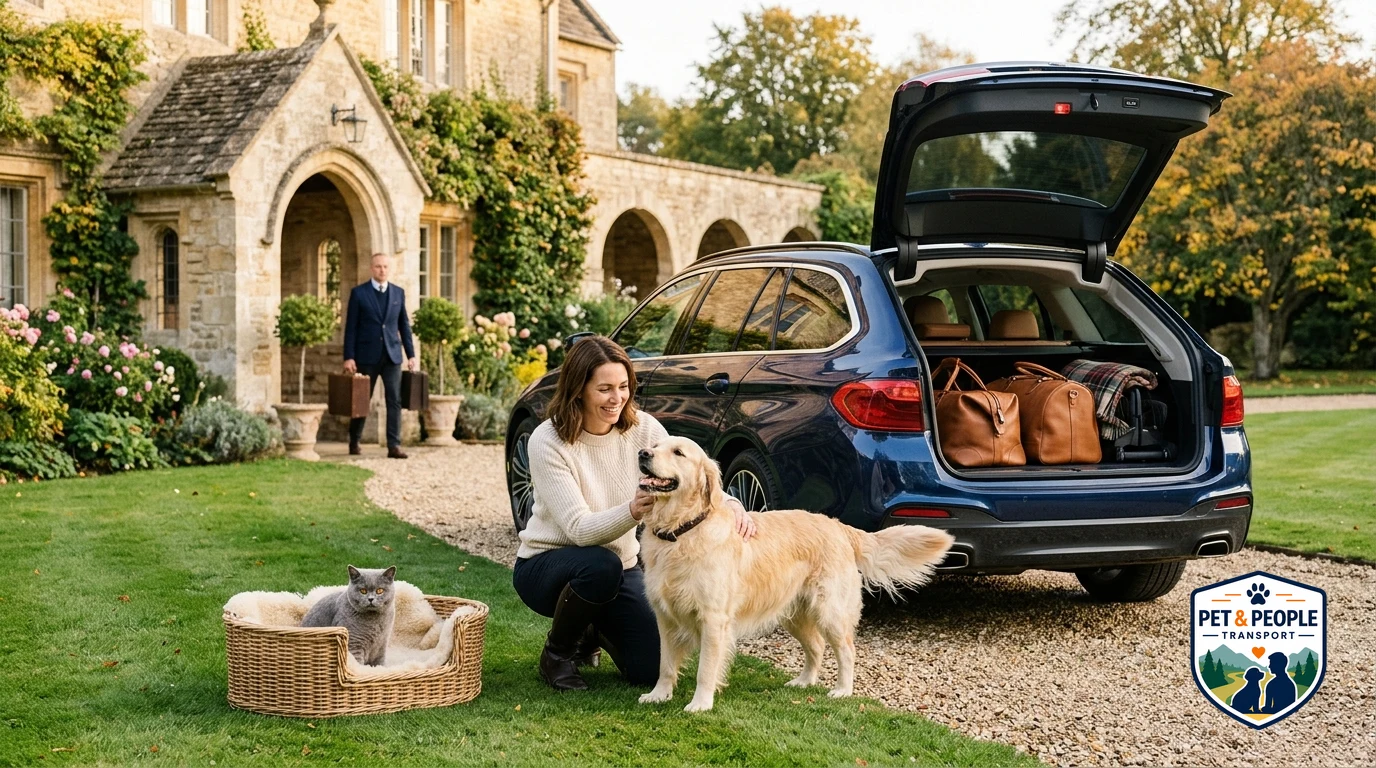
A peaceful, dignified homecoming: pets and family luggage arrive together at your UK residence without cage stress or courier delays.
Eurotunnel Calais Pet Reception: The Multi-Pet Check-In Walkthrough
The dedicated Eurotunnel Le Shuttle Pet Reception building at Calais (Coquelles) is the central clearance gateway for animals entering Great Britain. For a multi-pet household, clearing this facility smoothly requires organized documentation and calm handling.
Standard Eurotunnel Statutory Tariffs
Eurotunnel Le Shuttle charges an official statutory pet supplement of £22 per animal, each way for both dogs and cats (source: Eurotunnel Le Shuttle official public tariff, 2026). Guide and assistance dogs registered with an Assistance Dogs International (ADI) or International Guide Dog Federation (IGDF) accredited organization travel free of charge.
Step-by-Step Border Check-In Protocol
- Curbside Parking at Dedicated Pet Reception: Your chauffeur parks directly outside the Pet Reception building. The vehicle’s independent climate control keeps cats calm and comfortable inside the vehicle.
- Sequential Microchip Scanning:
- Dogs are walked on lead into the reception lanes. You or the DEFRA agent will pass the handheld scanner over the scruff between the shoulder blades until the 15-digit code beeps.
- For cats, you may either bring the cat inside their secure carrier or request an attendant scan the cat inside the vehicle to prevent escape risk. Never remove a cat from its carrier in an open parking lot.
- Document Verification: The agent cross-references each animal’s microchip number with:
- Rabies vaccination date and batch number.
- 21-day completion validity.
- Dogs’ tapeworm treatment timestamp (must fall strictly between 24 and 120 hours).
- Issuance of the Boarding Pet Sticker: Once verified, the agent issues the official green Eurotunnel pet windscreen token, allowing your chauffeur to proceed directly to the vehicle boarding lanes.
During the 35-minute underwater crossing, all animals remain securely inside the quiet vehicle cabin with you. There are no noisy ship decks, no dark cargo holds, and no separation anxiety.
Real-World Case Study: Relocating an Expat Household from Munich to Surrey
To illustrate how synchronized multi-pet travel operates in practice, consider the recent relocation of the Vance family, who moved from Munich, Germany, to Cobham, Surrey, with two Golden Retrievers (Leo and Bella) and one elderly rescue cat (Milo, age 12).
Case Profile: The Munich-to-Surrey Transit
- Route: Munich (Bavaria) → Frankfurt → Brussels → Calais → Eurotunnel → Surrey, UK (980 km total).
- The Challenge: Milo suffered from early-stage renal insufficiency and severe kennel phobia; commercial air cargo was deemed a lethal health risk by their German veterinarian. Commercial multi-drop courier vans quoted a 48-hour delivery window with multiple overnight cage transfers.
- The Solution: A dedicated, private door-to-door road shuttle in an executive BMW 5 Series Touring.
- Execution:
- Tapeworm treatment for Leo and Bella administered in Munich at 08:30 on Wednesday morning.
- Chauffeur departure from Munich at 09:30 Wednesday in the private BMW Touring.
- Leo and Bella occupied the rear seat with padded ISOFIX harnesses; Milo rested peacefully in his pheromone-sprayed carrier on the front passenger seat directly beside Mrs. Vance.
- Comfort stops conducted every 3 hours in rural parklands along the German Autobahn and Belgian motorway.
- Arrival at Calais Pet Reception at 21:15 Wednesday evening (12 hours 45 minutes into the 120-hour tapeworm window).
- Flawless Eurotunnel check-in: all 3 microchips verified in under 6 minutes.
- Doorstep arrival in Surrey at 23:45 Wednesday night. Total journey time: 14 hours 15 minutes.
- Outcome: Zero gastrointestinal distress, zero stress-induced feline illness, and the family slept in their new UK home that very night.
Essential Packing Checklist for Dual-Species Cross-Border Road Travel
When packing an executive estate vehicle for multiple companion animals, keep immediate travel necessities separated from bulk moving containers.
The Canine Kit
- Crash-tested safety harness with dual attachment rings.
- Two 1.5-meter non-retractable walking leashes (plus spare).
- Spill-proof silicone travel bowl and 5 liters of familiar bottled spring water.
- High-value treats and pre-portioned dry kibble for 48 hours.
- Biodegradable waste bags and gentle paw-cleaning wipes.
- Familiar orthopedic dog bed or fleece blanket.
The Feline Kit
- Rigid or reinforced soft-sided carrier with locking zippers and breathable mesh.
- Feliway Classic calming spray (applied to carrier fabrics 15 minutes before departure).
- Compact disposable travel litter tray with 2 kg of familiar non-clumping litter.
- Veterinary oral syringe or liquid hydration sachets (e.g. Purina Hydra Care).
- Soft fleece blanket carrying the home scent (do not wash immediately before travel).
- Prescribed veterinary calming medication (e.g. Gabapentin), clearly labeled with dosage.
The Master Documentation Folder
- Original EU Pet Passports or Great Britain Pet Health Certificates for each animal.
- Veterinary microchip registration certificates with matching 15-digit numbers.
- Rabies vaccination certificates with manufacturer batch stickers and vet signatures.
- Dog tapeworm treatment record with exact 24-hour time stamp.
- UK Customs Transfer of Residence (ToR1) approval letter (if relocating personal belongings).
Frequently Asked Questions
Conclusion: Effortless Door-to-Door Family Reassurance
Relocating across borders with dogs and cats does not have to be an ordeal of stressful separations, chaotic commercial vans, or bureaucratic uncertainty. When companion animals travel together in an executive estate vehicle dedicated exclusively to your household, the journey transforms into a peaceful, dignified European road trip.
Your pets remain by your side, your luggage travels securely in the same vehicle, and every regulatory requirement from Munich, Paris, or Madrid to your new doorstep in the United Kingdom is navigated with effortless precision.
Planning an upcoming cross-border move with your dogs and cats? Contact Pet & People Transport UK today to design your bespoke family travel itinerary.