
Flying a Pet to the UK Without Cargo: The Ultimate Guide to Avoiding Heathrow HARC & Manifest Freight Holds
For thousands of international pet owners relocating from North America, the Middle East, Asia, and distant corners of Europe, planning a move to Great Britain with a canine or feline family member is one of the most stressful undertakings of their lives. While overseas airlines routinely welcome small dogs and cats into the passenger cabin on international routes, the moment you attempt to book an inbound ticket touching down at a British airport, you are confronted with Britain’s strict statutory barrier.
Under aviation border rules enforced by the Department for Environment, Food and Rural Affairs (DEFRA), commercial passenger airlines are legally prohibited from flying pets into United Kingdom airports inside the passenger cabin. With the sole exception of recognized assistance dogs, every family pet flying directly into London Heathrow, Gatwick, or Manchester must be shipped as unaccompanied manifest air cargo.
For loving pet parents, consigning a companion animal to an icy, vibrating aircraft luggage hold—loaded alongside industrial freight pallets, exposed to deafening jet engine noise and tarmac exhaust fumes, followed by 4 to 8 agonizing hours of warehouse holding at the Heathrow Animal Reception Centre (HARC)—is an ordeal many rightfully refuse to contemplate.
Fortunately, there is a proven, humane, and vastly less stressful route favored by seasoned expatriates and discerning travelers: flying your dog or cat in-cabin to a major continental European airport (such as Paris Charles de Gaulle, Brussels, or Amsterdam) and completing the journey to Great Britain via a dedicated private road chauffeur through the Eurotunnel.
This definitive manual explains how the UK aviation cargo mandate works, dissects the true costs and emotional toll of Heathrow’s animal reception process, and shows you how to bring your companion home calmly, side-by-side, without ever setting foot in an aircraft cargo hull.
The UK Aviation Mandate: Why Pets Cannot Fly In-Cabin to London
To plan your journey effectively, it is essential to understand why airlines enforce this rule. It is not an airline policy—it is a British statutory instrument.
Mandatory Aircraft Cargo Hold
Commercial airlines touching down on British soil are legally barred from landing animals in passenger cabins or excess baggage.
- Pet must be booked as commercial freight (Air Waybill) via an international freight forwarder.
- Dropped off at cargo warehouses 4 to 6 hours before scheduled departure.
- Transported across noisy tarmac trailers in extreme weather before being loaded into the hull.
- Mandatory holding at Heathrow Animal Reception Centre (HARC) for 4 to 8 hours post-touchdown.
- Astronomical cargo tariffs and third-party customs clearance broker surcharges.
Fly In-Cabin to Europe + Private Chauffeur
Major international airlines allow small pets in the cabin on flights landing in continental European hubs.
- Your pet remains safe under your seat in the climate-controlled cabin the entire flight.
- Direct curbside terminal meet-and-greet in Paris CDG or Brussels by our executive chauffeur.
- Smooth overland transit in a spacious estate vehicle with tailored walking and hydration stops.
- Fast 35-minute Eurotunnel Le Shuttle crossing sitting together inside the private vehicle.
- Zero cargo warehouses, zero separation anxiety, and direct delivery to your UK door.
Pulling Back the Curtain: What Happens at Heathrow’s Animal Reception Centre (HARC)?
Many travelers assume that landing at London Heathrow means picking up their pet at the oversize luggage belt shortly after clearing passport control. In reality, the commercial air cargo import process is an industrial freight operation managed under statutory powers by the City of London at the Heathrow Animal Reception Centre (HARC).
The Reality of Direct Air Cargo Processing:
- Unloading into Freight Sheds: When an aircraft lands, animal crates are unloaded by ground baggage handlers alongside commercial containerized freight. They are transported across the active tarmac to the airline’s cargo holding warehouse.
- Transfer to HARC: A specialized airport animal transport vehicle collects crates from the airline warehouse and drives them across the airport perimeter to the HARC facility on the southern airfield boundary.
- Statutory Document & Health Verification: Veterinary inspectors inspect the microchip, scan the animal through cage bars, verify the rabies documentation, and check the tapeworm administration record.
- The 4 to 8-Hour Delay: On busy arrival days, dozens of flights deposit animals simultaneously. While pets are offered water in their crates, owners cannot enter the processing facility. You must wait in an airport hotel or terminal cafe for 4 to 8 hours (and occasionally overnight) before receiving the clearance phone call.
- The Financial Shocks: In addition to the airline’s freight charge (£1,500 to £4,000+), the City of London statutory HARC fee schedule begins at approximately £450 to £900+ per animal, plus customs clearance brokerage fees and statutory VAT declarations.
The Continental Solution: Flying In-Cabin to Paris CDG or Brussels
Major international carriers—including Air France, KLM, Delta Air Lines, United Airlines, and Lufthansa—routinely permit cats and dogs under 8 kg (including a soft-sided travel bag) to fly inside the passenger cabin on transatlantic and long-haul intercontinental flights landing in continental Europe.
The Gateway Airports Compared:
Paris Charles de Gaulle (CDG)
The primary transatlantic gateway for Air France, Delta, and United. Located 175 miles (280 km) from the Eurotunnel terminal at Calais.
- Drive time to Calais: ~2 hours 45 minutes on the quiet A1/A26 autoroutes.
- Bypasses central Paris entirely via northern orbital bypasses.
- Curbside meet-and-greet outside Terminals 1, 2E, 2F, or 2A.
Brussels Zaventem (BRU)
A serene, compact northern hub ideal for Star Alliance passengers (Brussels Airlines, United, Air Canada, Lufthansa).
- Drive time to Calais: ~2 hours 15 minutes via the E40 motorway.
- Gentle, traffic-free routing through Flanders and northern France.
- Outdoor relief lawns situated directly adjacent to terminal curbs.
Amsterdam Schiphol (AMS)
Major global hub for KLM and transatlantic SkyTeam partners. Excellent connectivity from the Americas and Asia.
- Drive time to Calais: ~3 hours 30 minutes via Belgium.
- Dedicated pet relief amenities outside Schiphol Plaza.
- Seamless terminal curb collection in our executive fleet.
The Terminal Meet-and-Greet: From Aircraft Cabin to Executive Estate
When you touch down in Paris or Brussels, your arrival protocol is seamless:
- Disembark Together: You walk off the plane with your pet in their carrier, exactly like any regular passenger.
- Standard EU Passport Control: You present your passport and your pet’s documentation at passport control. There are no industrial cargo sheds or holding cells.
- Baggage Reclaim: You collect your checked luggage from the standard baggage carousel with your companion beside you.
- Curbside Rendezvous: Your private chauffeur is already parked in the executive pick-up lane, actively tracking your flight status via live flight radar. We never charge waiting penalties for flight delays.
- Settling In: The chauffeur loads your luggage into the spacious boot of our executive estate vehicle (Mercedes-Benz E-Class Estate, BMW 5 Series Touring, or Volkswagen Passat Estate). Your pet stretches on the clean sidewalk before stepping into the climate-controlled cabin.
Solving the Veterinary Tapeworm Rule (*The 24h–120h DEFRA Window*)
Under UK biosecurity law, every dog entering Great Britain must be treated for tapeworm (*Echinococcus multilocularis*) using an approved medication containing Praziquantel.
The Timing Trap for Overseas Travelers
The treatment must be administered by a registered veterinarian no less than 24 hours and no more than 120 hours (5 days) before checking in at the Eurotunnel terminal in Calais.
- The Long-Haul Dilemma: If you administer the tapeworm treatment in the United States, Canada, or Asia before boarding an intercontinental flight, flight delays or overnight connections can push you past the 120-hour deadline before reaching Calais.
- The Chauffeur Solution: We frequently schedule a pre-booked appointment at an accredited veterinary clinic along our direct driving corridor in northern France (near Paris or Amiens). The French vet administers the tablet, records the exact time on the 24-hour clock, and applies their official practice stamp. This resets your countdown clock right before arriving at the Channel!
The Channel Crossing: Why the Eurotunnel Beats Maritime Ferries
When completing the journey from continental Europe into Great Britain, how you cross the English Channel makes all the difference:
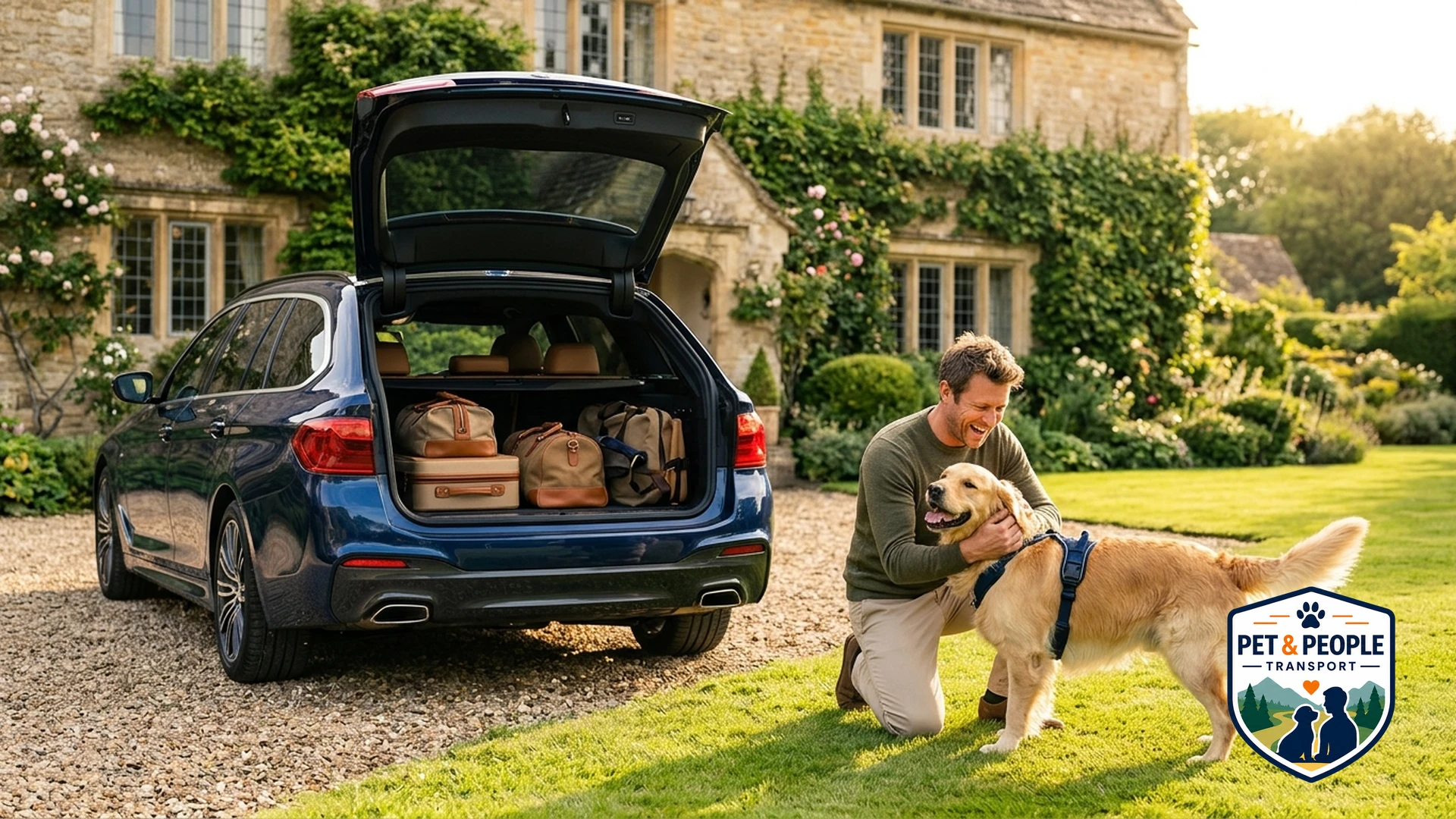
Arriving directly at your new UK doorstep in calm comfort, completely free of cargo warehouse stress and separation anxiety.
Why Eurotunnel Le Shuttle is the Gold Standard:
- Zero Separation: Commercial ferries prohibit animals from entering passenger decks; pets must remain locked alone on dark, noisy, vibrating vehicle decks for 90 to 120 minutes during rough sea crossings. On the Eurotunnel train, you and your companion stay seated together inside your vehicle in warm, quiet comfort.
- 35 Minutes on Smooth Rail: The train glides along smooth railway tracks beneath the seabed, completely eliminating maritime sea swell and canine motion sickness.
- Fast-Track Pet Reception: At the dedicated Eurotunnel Pet Reception building in Calais, official DEFRA staff scan your pet’s microchip through the car window and inspect the passport in under 10 minutes. Once cleared, we drive directly onto the shuttle carriage.
- Door-to-Door Delivery: Exiting the train at Folkestone, your chauffeur delivers you and your pet directly to your final residence anywhere in London, the Home Counties, the Midlands, the North, Scotland, or Wales.
Comprehensive Financial & Welfare Comparison: Direct Cargo vs. Fly & Drive Chauffeur
| Travel Factor | Direct Manifest Air Cargo to London (LHR) | Fly In-Cabin to Europe + Pet & People Chauffeur |
|---|---|---|
| Pet Travel Location | Locked in aircraft cargo hull with freight pallets | In cabin under seat, then executive estate leather seats |
| Separation Time | 12 to 18 hours continuous isolation | Zero separation: side-by-side the entire journey |
| Post-Flight Wait Time | 4 to 8 hours waiting outside cargo warehouses | Immediate curbside pickup in 15–20 minutes |
| Third-Party Fees | HARC statutory handling (£450–£900+) + customs agent fees | Official Eurotunnel pet ticket (£22 statutory fee) |
| Luggage & Passengers | Excludes human travel; severe excess baggage fees | Entire family and all personal suitcases ride together |
Frequently Asked Questions
1. Which international airlines allow dogs and cats in the cabin on flights to Paris or Brussels?
Major global airlines permitting companion animals in the passenger cabin on long-haul routes into continental European hubs include Air France, KLM, Delta Air Lines, United Airlines, Lufthansa, Swiss International Air Lines, and TAP Air Portugal. Weight limits typically require the pet plus soft-sided carrier to weigh 8 kg or less, so confirm your carrier’s specific pet baggage allowance when booking.
2. What happens if our international flight arrives with a delay?
At Pet & People Transport UK, our operations team tracks your inbound flight using live flight radar systems. Your chauffeur’s arrival at the terminal pick-up bay is synchronized with your real touchdown time and baggage collection. We never charge waiting penalties or overtime fees for airline flight delays.
3. Can my family and all our luggage travel inside the executive vehicle?
Yes, absolutely! That is the core advantage of our dedicated road service. Our fleet consists of long-wheelbase executive station wagons (Mercedes-Benz E-Class Estate, BMW 5 Series Touring, and Volkswagen Passat Estate) offering immense boot space. A standard family journey comfortably accommodates 2 to 3 large check-in suitcases, cabin bags, personal gear, and pet bedding at zero additional surcharge.
4. Do cats require a tapeworm treatment to enter Great Britain?
No. Under official DEFRA import regulations, the mandatory Praziquantel tapeworm treatment applies exclusively to dogs. Cats entering the UK require an ISO 11784/11785 compliant microchip, an up-to-date rabies vaccination administered at least 21 days prior to travel, and a valid EU Pet Passport or Great Britain Pet Health Certificate.
5. Can you deliver us directly to our UK destination outside London?
Yes. Our airport transfer service is 100% bespoke and door-to-door. Once we exit the Eurotunnel terminal at Folkestone, your chauffeur delivers you directly to your doorstep anywhere in Great Britain, including Greater London, the Home Counties, the Cotswolds, the Midlands, the North, Scotland, or Wales.
6. Can my pet travel unaccompanied if I need to take a direct flight to the UK?
Yes. If your professional schedule requires you to fly directly into London, our private chauffeurs frequently collect companion animals from Paris CDG, Brussels, or European addresses under our Unaccompanied VIP Care Protocol. Your pet remains the sole passenger in the car, receiving one-on-one attention, live GPS tracking, and regular photo and video updates sent straight to your phone throughout the journey.
Plan Your Stress-Free Airport Transfer with Complete Confidence
Relocating across borders or continents should be an exciting life transition, not a distressing endurance test for your four-legged companion. By choosing to fly into a welcoming continental airport with your pet safely in-cabin, and completing the cross-Channel journey in the quiet luxury of an executive road vehicle, you guarantee that your companion’s arrival in Great Britain is gentle, safe, and dignified.
Contact our dedicated international logistics team at Pet & People Transport UK today to receive your personalized, all-inclusive Bespoke Quote and begin your journey home in comfort.