
Transporting Large, Giant & Anxious Dogs to the UK: The Stress-Free Road & Eurotunnel Guide for Big Breeds
Relocating across international borders with a miniature poodle or a domestic cat requires careful planning; transporting an 85-kilogram English Mastiff, a sensitive German Shepherd, or an anxious Golden Retriever across European frontiers is a monumental logistical undertaking. For families with large, giant, or reactive dogs, standard travel advice is not merely unhelpful—it is often dangerous.
Modern commercial transport systems are fundamentally engineered around human passenger convenience and standardized cargo containers, leaving large canines in an agonizing operational blind spot. Under United Kingdom Department for Environment, Food & Rural Affairs (DEFRA) biosecurity regulations, companion animals cannot fly in the passenger cabin on commercial flights into British airports. For big dogs, this mandates placement into the belly of the aircraft as manifested cargo. Yet, once a dog exceeds 30 to 40 kilograms, major airlines impose severe weight restrictions, seasonal temperature bans, or demand custom-built reinforced wooden crates costing thousands of pounds.
Even when pet owners turn to surface transit, general commercial pet courier vans present severe hazards: tight metal cages stacked three high, cacophonous barking from dozens of unfamiliar dogs, and infrequent exercise breaks that induce profound psychological panic, motion sickness, and muscular stiffness.
For large breeds and sensitive dogs, true welfare demands a radically different philosophy: dedicated, cage-free executive road transit via Eurotunnel Le Shuttle. Traveling in a climate-controlled, long-wheelbase executive estate car with an orthopedic memory foam mattress, gentle kinetic driving, and their devoted owner sitting right beside them eliminates travel trauma entirely.
This comprehensive operational guide explores how owners of large, giant, and anxious dogs can navigate European cross-border transit to Great Britain with absolute safety, clinical comfort, and flawless regulatory compliance.
The Heavyweight Dilemma: Why Big Canines Face an Operational Travel Wall
Large breeds—such as Labrador Retrievers, Golden Retrievers, German Shepherds, Rottweilers, Boxers, and Dobermans—and giant breeds—including Bernese Mountain Dogs, Great Danes, Newfoundlands, Irish Wolfhounds, Saint Bernards, and Cane Corsos—present unique anatomical and behavioral profiles that commercial transport infrastructure simply cannot accommodate.
Three core physical and psychological factors create this challenge:
- Orthopedic Joint Compression & Muscular Stasis: Giant canines are predisposed to hip dysplasia, osteoarthritis, and cruciate ligament vulnerabilities. Forcing a 60kg dog into a rigid, cramped travel box for 10 to 18 hours causes acute stiffness, pressure sores (hygromas), and severe muscular cramping. Large dogs must have sufficient flat floor area to stretch out fully on supportive, pressure-relieving surfaces.
- Thermal Vulnerability & Respiratory Dynamics: Heavy-coated northern breeds (Newfoundlands, Huskies, Bernese Mountain Dogs) and brachycephalic mastiff breeds overheat rapidly under stress. Commercial cargo holds and uninsulated courier vans lack responsive microclimate control, leading to hyperthermia and respiratory distress.
- Heightened Noise Sensitivity & Claustrophobic Panic: Canines possess hearing four times more acute than humans. When confined to an enclosed metal or plastic crate inside an aircraft cargo bay—surrounded by 115-decibel jet engine roar, baggage thuds, and barometric pressure drops—sensitive dogs experience severe fight-or-flight panic. This sensory trauma can permanently alter a dog’s temperament, resulting in long-term noise phobias and separation anxiety.
Understanding these vulnerabilities underscores why treating a 50kg companion animal as a standard piece of freight is unacceptable to discerning pet parents.
The Airline Cargo Ceiling: Weight Bans, Custom Crates, and Cargo Trauma
When relocating from mainland Europe or overseas to the United Kingdom, pet parents frequently investigate air travel first, only to hit what industry professionals call “The Cargo Ceiling.”
The Airline Cargo Obstacle Course for Large Dogs
- Strict Weight Limits: Most commercial airliners cap total weight (dog + travel crate) at 75kg, excluding many giant breeds entirely.
- IATA CR-82 Custom Crates: Powerful breeds require reinforced wooden crates costing £1,200 to £2,500+ before freight costs.
- Aircraft Cargo Door Caps: Oversized wooden containers often cannot physically fit through the cargo doors of standard passenger aircraft.
- Seasonal Temperature Embargoes: Flights are frequently cancelled or rescheduled if tarmac temperatures exceed 27°C or drop below 7°C.
- Exhausting HARC Processing Delays: Arriving pets face 4 to 8-hour delays in unfamiliar holding kennels at the Heathrow Animal Reception Centre.
The IATA CR-82 Wooden Crate Requirement
Under International Air Transport Association (IATA) Live Animals Regulations (Container Requirement 82), powerful and giant breeds—such as Mastiffs, Rottweilers, German Shepherds, and Cane Corsos—are classified as restricted. Airlines refuse to accept standard commercial plastic flight kennels (like Variocages or Petmate Sky Kennels).
Instead, owners must commission a bespoke, custom-built wooden crate constructed from solid wood or marine plywood, bolted with steel rebar and heavy-duty wire mesh. For a Great Dane or Irish Wolfhound, an IATA CR-82 crate weighs between 40 and 65 kilograms on its own.
When added to the dog’s body weight, the combined freight weight frequently reaches 110 to 140 kilograms. At this threshold:
- Most passenger airliners (Airbus A320, A330, Boeing 737) physically cannot load the container through their cargo doors.
- Freight handling fees skyrocket to £4,000 to £7,000+ according to commercial airfreight tariffs.
- The pet must be delivered to an industrial air cargo facility 4 to 6 hours before flight departure, followed by mandatory holding delays at the London Heathrow Animal Reception Centre (HARC).
For an exhaustive breakdown on bypassing these aviation traps, read our detailed analysis on avoiding Heathrow HARC cargo holds.
The Commercial Courier Pitfall: Stacked Cages and Sensory Overload
Faced with the prohibitive costs and risks of flying, many dog owners seek road transport, turning to generic pet couriers. However, multi-animal courier vans present severe welfare concerns for large and reactive dogs.
The Commercial Courier Van
- 12 to 18 unfamiliar dogs and cats stacked in tight wire cages.
- Continuous high-pitched barking and whining triggering acute sensory stress.
- Rigid, commercial delivery itineraries across 5 countries with minimal walking breaks.
- Zero owner companionship—the dog travels with strangers in total isolation.
- High risk of infectious kennel cough (Bordetella) and gastrointestinal flare-ups.
Pet & People Private Executive Chauffeur
- 100% Sole Occupancy: Only your family and your dog in an executive estate vehicle.
- Completely cage-free on 15cm medical-grade orthopedic memory foam.
- Full owner accompaniment: You travel right beside your canine companion.
- Flexible comfort stops every 2 hours at tranquil, open green spaces.
- Whisper-quiet acoustic cabin with individualized dual-zone air conditioning.
For a sensitive dog, being confined next to reactive, barking canines in a bouncing commercial van elevates cortisol levels to traumatic heights. By contrast, a private estate car preserves the dog’s normal domestic emotional state throughout the journey.
The Executive Estate Sanctuary: Engineering True Canine Ergonomics
At Pet & People Transport UK, we reject commercial transport vans entirely. Instead, our official fleet consists exclusively of long-wheelbase executive estate vehicles: the Mercedes-Benz E-Class Estate, the BMW 5 Series Touring, and the Volkswagen Passat Estate.
These vehicles represent the pinnacle of canine travel ergonomics for four critical reasons:
1. 15cm Medical-Grade Orthopedic Memory Foam
Rather than rigid plastic or thin blankets, the entire rear passenger seating compartment is converted into an expansive orthopedic lounge. A high-density memory foam travel mattress cushions heavy joints, absorbs road shocks, and supports the musculoskeletal frame of giant dogs weighing up to 90kg.
2. Progressive Kinetic Driving Techniques
Our chauffeurs are specifically trained in animal kinetics. Sudden braking, sharp cornering, and rapid acceleration induce vestibular disorientation and nausea in large dogs. Our drivers utilize smooth, progressive deceleration curves and wide-radius turning, allowing large canines to maintain their equilibrium without bracing or sliding.
3. Whisper-Quiet Double-Glazed Acoustic Comfort
Exterior highway buffeting and diesel engine clatter are primary triggers for travel anxiety. Our executive estate cars feature acoustic laminated glass and advanced sound-dampening insulation, maintaining cabin ambient noise below 62 decibels at cruising speeds—comparable to the quiet of a private living room.
4. Direct Owner Proximity
Canines are social pack animals that look to their human guardians for emotional security. Sitting right next to their owner in the rear cabin allows constant physical touch, reassuring verbal cues, and immediate comfort during border checks or unfamiliar traffic environments.
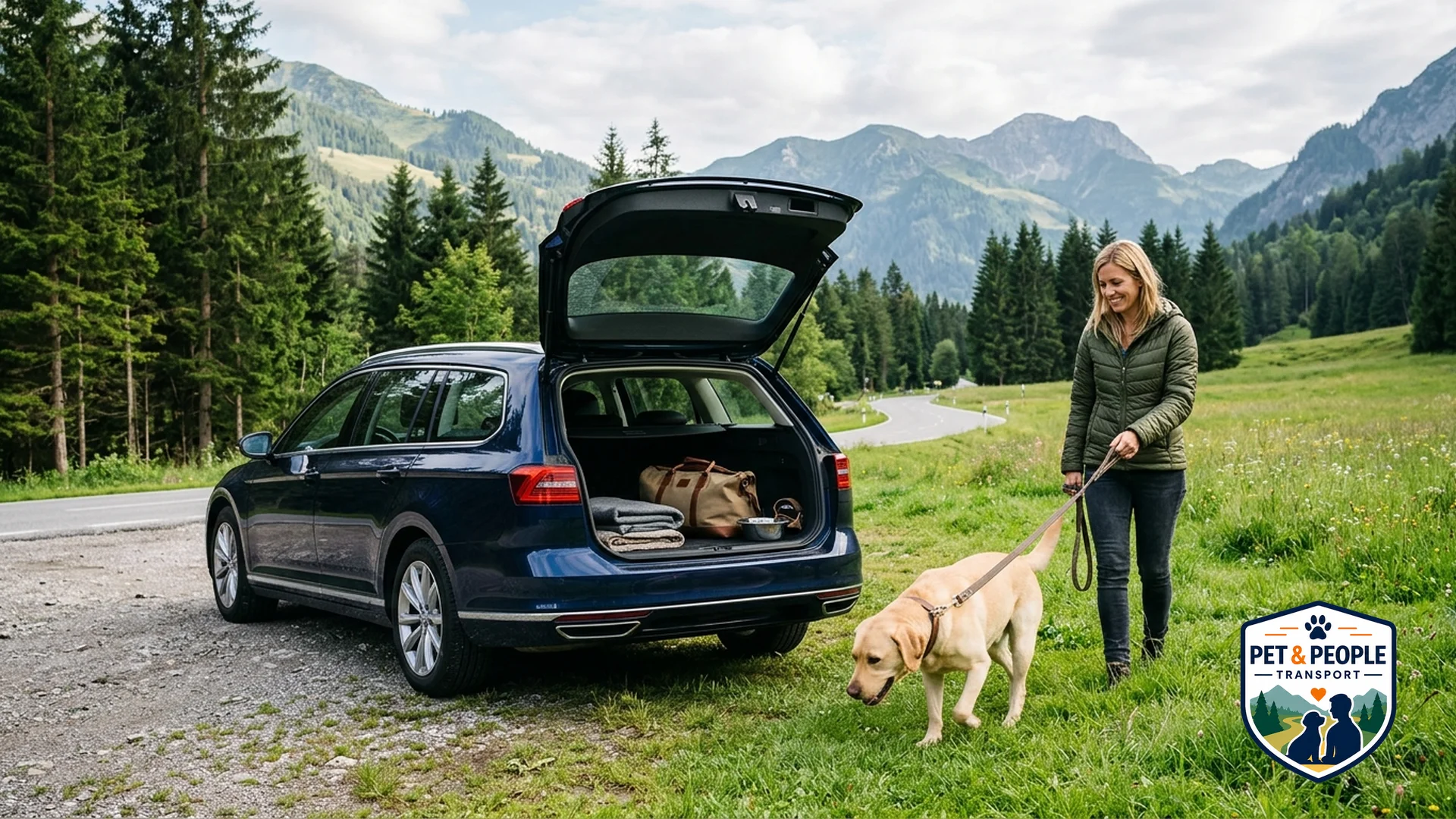
Quiet European green rest stop with a Volkswagen Passat Estate for large family dog travel
The Eurotunnel Le Shuttle Advantage for Large Breeds
Crossing the English Channel is the critical gateway into Great Britain. While cross-channel passenger ferries exist, they present profound obstacles for big canines.
On conventional ferries (such as Dover to Calais), passengers are strictly prohibited from remaining on the car decks during the 90-minute crossing. Your dog must either remain alone in the car amidst vehicle alarms and engine hum, or be led into a communal, steel-barred shipboard kennel facility. For a large or anxious dog, navigating metallic stairs, shipboard crowds, and unfamiliar scents causes profound agitation.
Why Eurotunnel Le Shuttle is Unrivaled for Big Dogs:
- Zero Physical Disembarkation: Your dog never has to walk across busy public ferry decks or embarkation ramps. They stay comfortably inside the climate-controlled car from motorway to train carriage.
- Continuous 35-Minute Underwater Transit: The rail journey beneath the Channel seabed takes just 35 minutes. It is smooth, level, and entirely devoid of sea swells or motion sickness.
- Continuous Human Companionship: You remain seated beside your dog throughout the entire transit. If your dog needs a sip of water or a soothing stroke, you are right there.
- Dedicated Outdoor Exercise Areas: Both the Folkestone and Calais Eurotunnel terminals feature secure, fenced, artificial-turf pet relief parks where large dogs can safely stretch their legs and relieve themselves before boarding.
To learn more about the mechanics of the shuttle, review our guide on why Eurotunnel is the ultimate choice for your dog.
Canine Behavioral Protocols: Managing Nervous, Reactive, and Motion-Sensitive Dogs
Transporting an anxious or reactive dog demands disciplined behavioral choreography. When you book a private chauffeur with Pet & People Transport UK, we implement proven clinical protocols to ensure tranquility:
A. Pre-Travel Sensory Preparation
- Familiar Scents: We advise bringing an unwashed fleece blanket or an item of clothing carrying your home scent to place atop the orthopedic travel mattress. Familiar olfactory markers trigger positive neurochemical grounding.
- Natural Pheromone Cocooning: The vehicle cabin can be pre-treated with Adaptil (dog appeasing pheromone) spray 15 minutes before pickup, releasing synthetic analogues of maternal calming pheromones into the air.
- Nutritional Fasting Window: To prevent motion nausea, feed your dog a light meal 4 to 6 hours before departure, withholding heavy kibble immediately prior to road travel while ensuring continuous access to fresh water.
B. Bi-Hourly Enrichment Breaks
Large canines require regular circulatory movement. Our chauffeurs plan unhurried comfort stops every 2 to 2.5 hours along scenic, low-traffic European rest pavilions. Rather than stopping at noisy commercial truck plazas, we utilize tranquil green spaces where your dog can sniff grass, hydrate from a fresh water dispenser, and release muscular tension safely on a secure lead.
C. Low-Stress Veterinary Pre-Audits
Our dispatch team performs a comprehensive document audit 48 hours prior to departure. By verifying that microchip numbers, rabies dates, and tapeworm timestamps are 100% compliant before the car moves, we eliminate anxiety-inducing delays at the French border.
Step-by-Step DEFRA Border Compliance for Large Canines
Entering Great Britain with a dog requires rigorous adherence to DEFRA biosecurity standards. Because large dogs require specialized handling, border officials at the Calais Eurotunnel Pet Reception look for precise documentation:
1. ISO 11784/11785 Compliant Microchip
The microchip must be a standard 15-digit non-encrypted transponder. Crucially, the microchip must have been implanted and officially scanned before or on the exact date of your dog’s rabies vaccination. If the rabies vaccine was given even one day before microchip implantation, DEFRA invalidates the vaccine, requiring a complete revaccination and a mandatory 21-day incubation wait.
2. The Weight-Accurate Tapeworm Protocol
Every dog entering the UK must receive an authorized tapeworm treatment containing Praziquantel administered by a licensed veterinarian in mainland Europe between 24 hours and 120 hours (5 days) before scheduled Eurotunnel vehicle check-in.
- Accurate Veterinary Dosing: For large and giant breeds, veterinarians must dose the medication strictly according to the dog’s exact body weight (typically 1 tablet per 10kg). Ensure your European vet explicitly records the dosage and pet weight in the passport.
- The Precise Timestamp: The vet must record the date and the exact minute of administration, verified by their clinical stamp and signature.
3. Calm Scanning Etiquette at the Calais Terminal
At the Eurotunnel Pet Reception Centre in Calais, pet owners scan their own dog’s microchip using a handheld scanner provided through the car window. For large or protective breeds, this setup is ideal: your dog remains comfortable inside the familiar vehicle cabin, avoiding the stress of being approached by strangers in a clinical examination room.
To evaluate overall costs and fees associated with bringing a pet into the UK, consult our transparent European pet transport cost breakdown.
Modal Comparison: Large Canine Transport Across Europe
| Transport Factor | Airline Manifest Cargo | Multi-Animal Courier | Pet & People Private Chauffeur |
|---|---|---|---|
| Maximum Dog Weight | Strict airline caps (Often < 75kg total) | Crate size limited | Unlimited (Any large/giant breed) |
| Caging Requirement | Rigid IATA CR-82 wooden box | Stacked commercial wire cages | 100% Cage-free orthopedic bed |
| Owner Presence | Strictly separated | Strictly separated | Travel together in same vehicle |
| Acoustic Stress Level | Extreme (115dB+ jet engine roar) | High (Barking van pack) | Serene (< 62dB acoustic glass) |
| Exercise & Walk Routine | Zero breaks during transit | Brief communal yard stops | Every 2 hours at green pavilions |
Frequently Asked Questions
1. Can my large or giant breed dog travel without a cage in your vehicles?
Yes. 100% cage-free travel is our core service philosophy. Across the rear passenger cabin of our executive estate cars (Mercedes E-Class, BMW 5 Series Touring, VW Passat Estate), we install a thick 15cm orthopedic memory foam mattress. Your dog is secured comfortably and safely with an ergonomic, crash-tested padded chest harness, allowing them to stretch out fully and rest naturally beside you.
2. What is the maximum dog weight or size limit for Pet & People Transport UK?
We have no arbitrary weight limits. We routinely transport giant breeds weighing 70kg to 90kg+ (such as Bernese Mountain Dogs, Great Danes, Newfoundlands, Mastiffs, and Irish Wolfhounds). Our estate vehicles offer extensive flat floor space designed to accommodate giant anatomies comfortably without joint compression.
3. How do your chauffeurs accommodate dogs with severe noise anxiety or motion sickness?
Our vehicles feature acoustic double glazing and adaptive suspension that dampens road vibration and outside engine noises. Chauffeurs drive with progressive kinetic deceleration, eliminating sharp turns and hard stops. Furthermore, we schedule custom exercise stops every 2 hours at quiet, open green areas, away from crowded motorway service stations.
4. Why is Eurotunnel Le Shuttle better for large dogs than a ferry crossing?
On ferries, foot passengers and drivers must leave their pets alone on noisy car decks or in shared kennels for several hours. On Eurotunnel Le Shuttle, the crossing takes just 35 minutes underwater, and your dog stays right beside you inside our private, climate-controlled car the entire time. There is zero sea sickness, zero crowd stress, and zero separation anxiety.
5. What veterinary documents does my large dog need to enter the UK?
Your dog requires an ISO 11784/11785 microchip, a valid rabies vaccination (administered at or after 12 weeks of age with a 21-day incubation wait), an EU Pet Passport or UK Animal Health Certificate (AHC), and an official tapeworm treatment (Praziquantel) administered by an EU vet strictly between 24 and 120 hours before Eurotunnel check-in, dosed accurately to their weight.
6. How do I request a personalized quote for transporting my large dog?
We create 100% bespoke quotes tailored to your exact pickup address, destination, dog breed, weight, and preferred travel date. Simply fill out our quote request form at Get a Quote, and our team will get in touch with a customized travel proposal.
—Conclusion: Dignity, Comfort, and Peace of Mind for Your Best Friend
A large dog is not freight, and an anxious dog cannot be healed by being enclosed in a cargo box. Choosing private executive road mobility is an investment in your dog’s lifelong physical health, emotional stability, and the bond you share as a family.
Whether you are bringing a beloved family Golden Retriever home from a European holiday, relocating a Great Dane to an estate in Surrey, or moving a sensitive rescue German Shepherd to London, Pet & People Transport UK provides the gold standard in bespoke, cage-free cross-Channel chauffeur mobility.